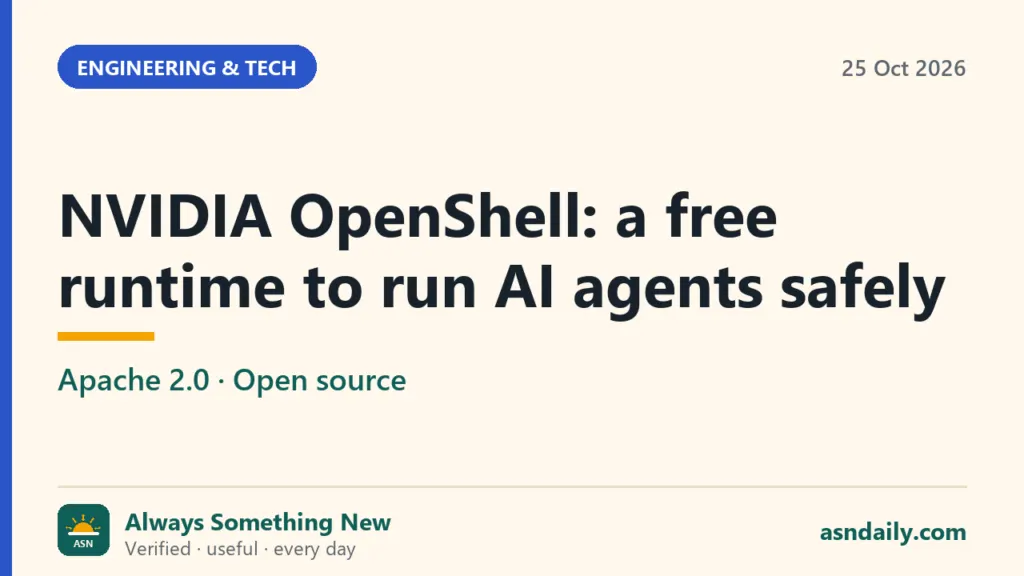
NVIDIA’s OpenShell is an open-source runtime for autonomous AI agents. On its GitHub page it is described as “the safe, private runtime for autonomous AI agents”. It is released under the Apache License 2.0 and has SDKs for Python, TypeScript, Go and Rust. Last checked: 25 Oct 2026.
What it is
An AI agent is a program that uses an AI model to carry out tasks on its own, such as running commands, reading files or calling other services. Because an agent acts without a person approving every step, where and how it runs matters. A runtime is the layer that sits underneath and runs the agent. OpenShell is NVIDIA’s open-source project for that layer, and the project says its aim is to make this runtime safe and private.
The project’s page describes a command line tool plus a local gateway, which you can install in one step. For larger setups, the gateway can be deployed on Kubernetes using Helm. We have not read the install script itself, so we describe only what the page says and do not make claims about its internals.
Who it is for
This is mainly for software engineers and small teams who are building or running AI agents and want a defined environment for them to run in. Developers who prefer Python, TypeScript, Go or Rust can use the SDK in their own language. It is not a tool for people who just want to use a chatbot.
It is also useful for students learning how agent systems are put together, since the code is public and the licence allows study and reuse.
What to do
- Open the project page on GitHub and read the README fully before installing anything.
- Check which SDK matches the language of your project.
- For a trial on one machine, use the CLI and local gateway setup that the README describes.
- For a team setup, check that your Kubernetes cluster meets the requirements listed below before deploying the gateway with Helm.
The README gives an install command that downloads a script from the project’s repository and runs it. As with any such command, open the script and read it before you run it, and try it first on a test machine rather than your main one.
What to watch out for
The page states one clear requirement for the Kubernetes route: the cluster’s network plugin must enforce NetworkPolicy. If it does not, the network rules you set will not be applied, so check this first.
Also, some things are not stated on the page. When we checked, the Releases section was empty, so there is no release tag or date to quote. The page does not give any price; the licence is Apache 2.0, which allows free use, but we have not seen a statement about paid support. The page shows a large number of GitHub stars, but stars only show interest, not quality or safety, so judge the project on its documentation and your own testing.
A runtime that is described as safe does not remove your own responsibility. Decide what files, accounts and networks an agent can reach, and start with the least access it needs.
Source and verification
Checked against NVIDIA OpenShell on GitHub on 25 Oct 2026. The licence, the description, the SDK languages and the Kubernetes and NetworkPolicy requirement are taken from that page.
Get one useful update every day
Verified, short, free. Join our Telegram channel: t.me/asn_daily · Instagram: @asn_daily